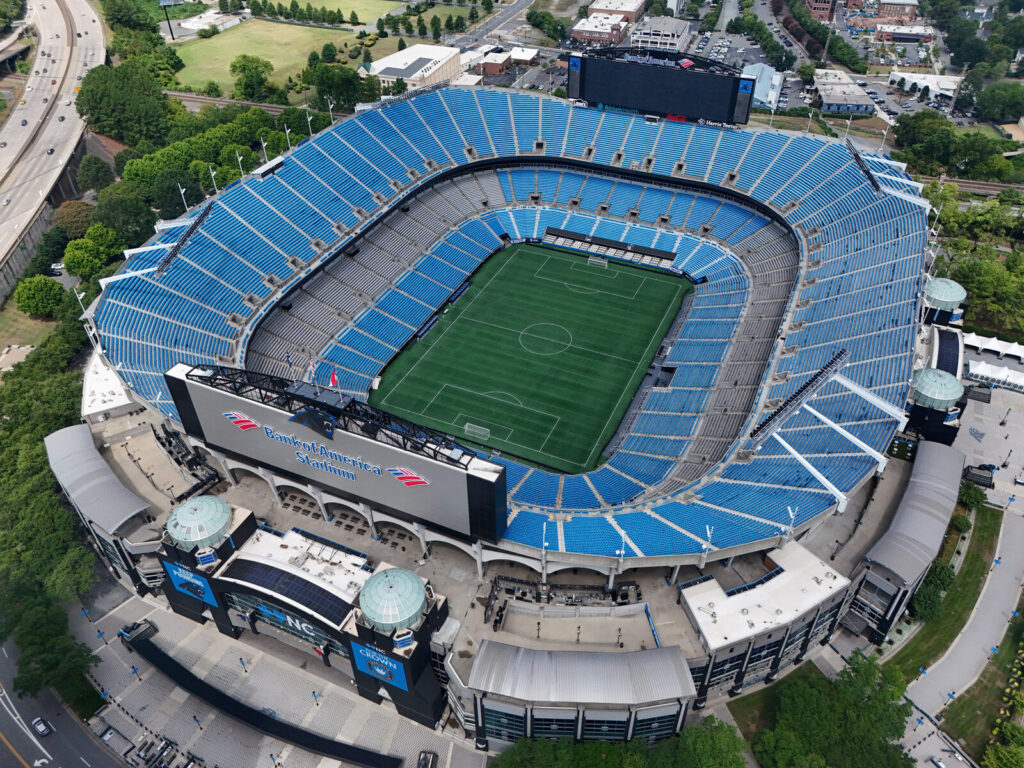
David Tepper is putting another $500 million of his own money into Bank of America Stadium, and the new number changes the shape of the whole project. The Panthers stadium renovation cost now stands at $1.3 billion, up from the roughly $800 million plan the team first laid out in 2024. The timing is not an accident. Team and city officials are framing the expanded overhaul as part of the case for landing a future Super Bowl, an NFL Draft and events tied to the run-up to the 2031 Women’s World Cup.
What The Extra Money Actually Buys
The added investment is going toward a specific, itemized list of upgrades. Plans call for a 4,400-seat music venue built to host 80 to 100 events a year, a new 500-level social patio with views over Uptown Charlotte, expanded retail and food and beverage options, bigger scoreboards and displays, and more restroom capacity. The stadium’s black metal perimeter gates are coming down in favor of a more open, park-style setting around the building. The most visible change will be the exterior itself: a “signature illuminated crown” wrapping the upper level, meant to give the 30-year-old stadium a new silhouette on the Charlotte skyline once construction wraps up around 2030.
A Naming-Rights Deal Timed To The News
Tepper’s extra $500 million landed alongside a separate but connected announcement: a long-term extension of Bank of America’s naming rights on the stadium. Owner David Tepper called it a reflection of “the strength of our partnership and our shared commitment to the Carolinas,” while Bank of America chair and CEO Brian Moynihan pointed to the stadium’s role in “attracting millions of visitors, driving economic opportunity” for the region. Pairing a renovation of this scale with a naming-rights renewal is a familiar sequence around the NFL’s biggest stadium deals, where a fresh building or a fresh look tends to arrive with a fresh price tag attached to the name above the gate.
The Math Behind The Number
Break down how the $1.3 billion is actually funded and a cleaner story emerges. Charlotte committed $650 million to the project back in 2024, and Tepper Sports and Entertainment put up $150 million of its own on top of that for the original $800 million plan. The new $500 million is entirely private, funded by TSE, which brings the ownership side’s total contribution to $650 million as well. Public and private money are now covering the project in an even split, each side at $650 million, a change from the original plan where the city’s share was the larger of the two. Spread across the stadium’s 75,037 seats, the $1.3 billion works out to roughly $17,300 per seat, a figure that says less about ticket prices and more about how expensive it has become to keep an NFL venue competitive three decades after it opened in 1996.
Betting On Charlotte As A Host City
The events wish list is where the renovation’s real purpose comes through. “We would love to get a Super Bowl,” said Panthers president and TSE CEO Kristi Coleman, adding that “doing projects like this help you get it,” while acknowledging the upgrade alone is no guarantee. NFL commissioner Roger Goodell struck a similar note of patience rather than promise, saying that if Charlotte’s growth continues, hosting a Super Bowl is “probably somewhere down the line.” That caution matters. Stadium renovations function as a prerequisite for Super Bowl and Draft bids. They do not punch that ticket automatically, and Charlotte is competing against cities that have already hosted or are already scheduled to host.
Still, the sequencing tells its own story. A stadium that opened in 1996 is being rebuilt around hospitality, music and open sightlines, a broader ambition than simply installing bigger video boards. That approach tracks with how the league now scores bid cities as much on year-round activation as on raw seat count. For context on why that shift matters to a franchise’s bottom line, the broader economics behind major stadium deals show teams increasingly treating the building itself as a revenue engine that runs every day of the year, well beyond kickoff. Charlotte will not know for years whether the bet on a Super Bowl or a Draft pays off. What is already locked in is the bill, the design, and a 2030 deadline for delivering both.