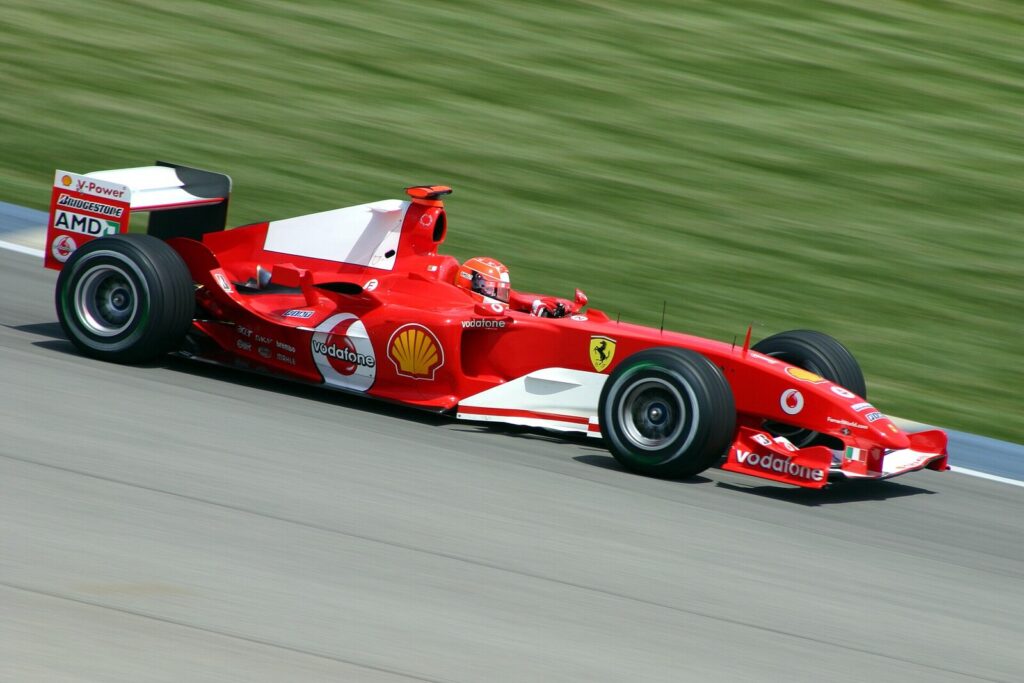
Cars flash past the old, preserved banking near Curva Alboreto and dive under the flyover bridge, a relic of a different era of racing still visible in the background as the field screams through Monza at close to full throttle for roughly 80% of every lap, because this is the temple of speed where Ferrari has built a home-track record no other constructor comes close to matching. The Autodromo Nazionale Monza will host the 2026 Italian Grand Prix on September 6, over 53 laps of the 5.793 km circuit for a race distance of 306.72 km, and whenever the tifosi fill the grandstands here they are watching a team that has won at this track 20 times, the most of any constructor in the sport’s history.
That number did not appear overnight. Monza was built in just 110 days back in 1922, making it the world’s third purpose-built race track after Brooklands in the United Kingdom and Indianapolis in the United States, and it opened on September 3 of that year before hosting its first Italian Grand Prix barely a week later. When the Formula 1 World Championship began in 1950, Monza joined the calendar immediately and has hosted the Italian Grand Prix every single year since with only one exception, a run of continuity that has given Ferrari seven decades of home races in which to pile up victories in front of its own fans. That uninterrupted presence on the world championship calendar since 1950, missing just a single year, is part of why Monza’s history and Ferrari’s record there feel so tightly bound together.
Ferrari’s 20 wins at Monza is nearly double the tally of the next-best team, McLaren, which sits second with 11 victories at the circuit. That gap reflects a structural advantage, built race after race across generations of Ferrari drivers on a track the team has always treated as its own backyard. No other manufacturer has managed to close that distance, and the 11-win gap between first and second place is as much a measure of Ferrari’s identity as it is a simple statistic.
The most recent chapter came from Charles Leclerc in 2024, when he won using a bold single-stop pit strategy that carried him home 2.6 seconds ahead of Oscar Piastri, with Lando Norris completing the podium in third. That victory mattered beyond the trophy because Ferrari’s previous Monza win had come back in 2019, also with Leclerc behind the wheel, meaning the team had gone five years without winning in front of its own fans before finally breaking through again. Five years is a long drought by Ferrari’s own home standards, and it explains why the reaction in the grandstands, and from Leclerc himself, went well beyond the usual celebration for a single race win.
Further back in that same 2024 field, Lewis Hamilton crossed the line fifth, a result that turned out to be his final Monza appearance for Mercedes before he moved across the paddock to join Ferrari for the 2025 season, an outcome that added an extra layer of symbolism to a result already shaped by Ferrari’s home-track dominance. Max Verstappen finished sixth that day, a result that extended his winless run to six consecutive races at the time. For a deeper look at how the sport’s machinery has evolved to chase exactly that kind of straight-line performance, Playbookwire has traced the technology that changed modern racing, and the grid itself keeps shifting too, as detailed in this look at Cadillac’s 22-car grid reviving F1’s 2016 qualifying rule.
None of that context diminishes what Leclerc’s 2024 win meant to the man who delivered it, since Monza sits alongside Monaco as the two races that carry the most personal weight for him on the calendar. Full details on the 2026 event, including timing and ticketing, are available through Formula1.com’s official Italian Grand Prix page. After crossing the line in front of the tifosi, Leclerc put it simply: “Monaco and Monza are the two races I want to win every year. These are the two most important races of the season and I managed to win them this year. It’s so, so special.”