The Hungarian Grand Prix arrives July 24-26 as round 11 of the 2026 F1 season, one week after Spa, where Ferrari found itself under FIA scrutiny in the Ardennes forest. That circuit rewards horsepower and the nerve to keep your foot down through Eau Rouge. The Hungaroring rewards neither. Type “why is it hard to overtake at Hungaroring” into a search bar and the short answer is that the track outside Budapest was built like a go-kart circuit squeezed into a natural bowl, and go-kart circuits do not leave much room to pass.
Monaco Without the Walls
Hungaroring measures 4.381 kilometers and packs 14 corners, six left-handers and eight rights, into that short lap, according to Formula1.com’s own circuit page. There is exactly one real straight, the run down to Turn 1, and it is short enough that a car with a genuine speed advantage rarely gets a clean tow before the braking zone arrives. The “Monaco without the walls” label gets attached to this place for a reason. It is a street-circuit-style layout dropped onto a permanent facility, minus the guardrails that punish a mistake at Monte Carlo.
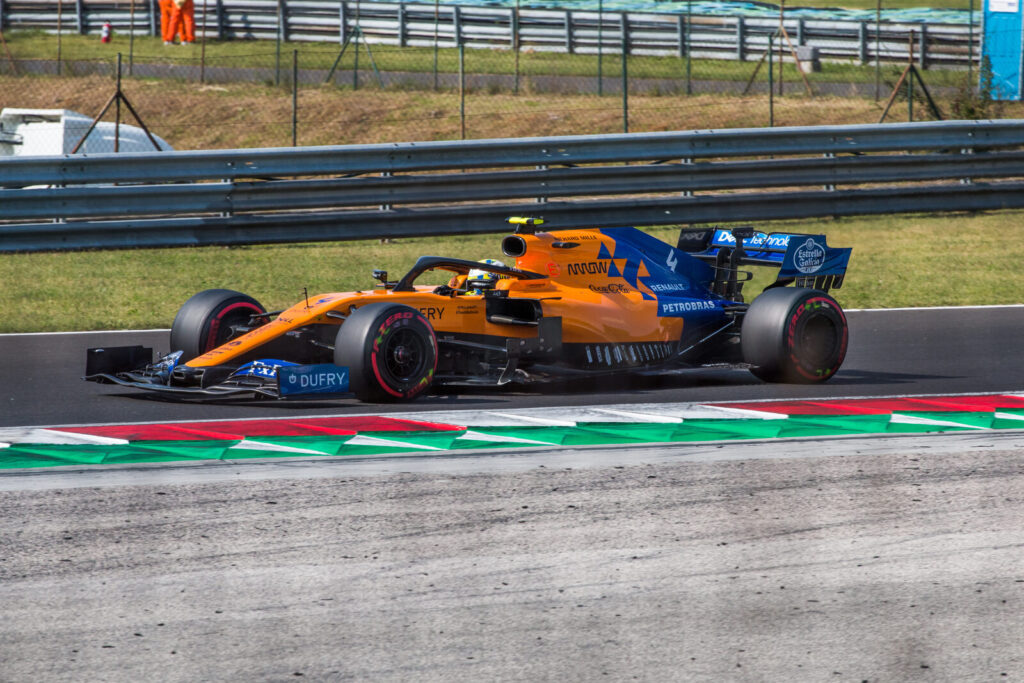
Track width compounds the issue. Plenty of modern circuits open up to 20 meters across on their straights. Hungaroring rarely exceeds 12 to 15 meters, even at the pit straight, and off the racing line the asphalt is dusty and low-grip. A driver attempting a pass often ends up with worse traction than the car ahead, even sitting in the faster machine.
The Numbers Back Up the Reputation
Formula1.com publishes a “Need to Know” stats package ahead of every round, and the recent editions put real figures on Hungaroring’s passing problem. Previewing the 2024 race, the site listed “overtakes completed in 2023 – 51”; a year later, previewing 2025, it counted 65 for the 2024 race. Compare that with Bahrain, a circuit built around long straights and multiple DRS zones, which logged 80 overtakes in 2023 by that same official count. Hungaroring can still produce a busy afternoon in the right year. It just does so despite its layout rather than because of it, and even its better recent seasons trail what a genuine passing track like Sakhir manages routinely.
Hamilton’s Eight Wins Say the Quiet Part Out Loud
Nothing illustrates the track’s character better than how directly qualifying position converts into the race result. Lewis Hamilton has won at Hungaroring eight times, matching Michael Schumacher’s record for most victories at a single circuit, and he also holds the track’s pole record with nine, per Formula1.com’s own stats. A gap of just one between poles and wins is barely a gap at all. At a circuit where the driver starting first rarely gets passed, and the driver starting eighth rarely climbs into the points without help from a safety car, grid position edges close to destiny. It’s the same theme driving the story a week earlier at Spa, where Hamilton is still chasing Schumacher’s record for wins at that track. At the Hungaroring, he has already tied it outright, and nobody has caught him since 2020.
Will 2026’s New Rules Change Any of This
Formula 1 swapped the DRS button for an automatic, three-mode active aero system for 2026, and the early results nearly tripled on-track passing at some venues, Melbourne chief among them. Neither Melbourne nor Suzuka, the other big riser, resembles Hungaroring in any meaningful way. Those tracks reward exactly what the new Overtake Mode was built to reward: a real straight-line speed delta that a trailing car can convert into a pass under acceleration. Hungaroring simply doesn’t offer that kind of straight. Its one meaningful braking zone is short, and the rest of the lap is medium- and low-speed corners where extra electrical deployment matters less than mechanical grip and getting a front tire to the apex first. Track position has decided this race for four decades, long before DRS existed and long before anyone dreamed up an Overtake Mode. Until the Hungaroring proves otherwise on July 26, geometry still looks like the bigger factor than any 2026 rulebook.