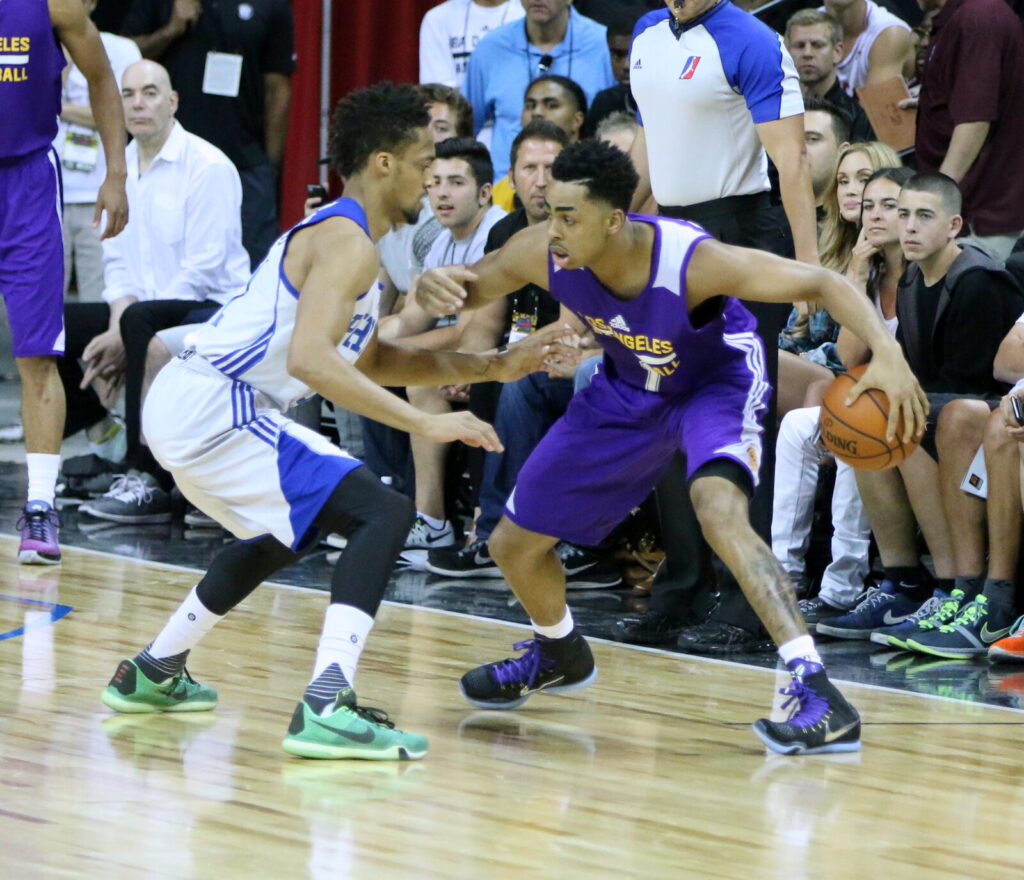
Type “NBA Summer League format” or “NBA Summer League playoffs bracket” into a search bar this week and the results land squarely inside a live tournament. Four teams, the undefeated Los Angeles Lakers, the Golden State Warriors, the Memphis Grizzlies and the Houston Rockets, play semifinal games at the Thomas & Mack Center in Las Vegas on Saturday, July 18, with the winners meeting Sunday for the championship. The bracket looks tidy once it is finally set. Getting there involves a round-robin group stage, a scoring format that only exists for these two weeks, and a tiebreaker formula that decided the last open bracket slot by a matter of decimal points.
How do teams qualify for the Las Vegas bracket?
All 30 NBA teams play in the Las Vegas Summer League, and every one of them is guaranteed four games first. Records from those four games set the standings, and only the top four teams advance to Saturday’s semifinals. The other 26 teams do not go home empty-handed; they play a fifth “placement” game sometime between July 17 and July 19 that has no bearing on the championship but keeps every roster on the floor one more time. That is the whole appeal of Vegas versus a traditional playoff conference bracket: nearly every team plays the same four games, then the math sorts out who keeps playing.
What happens in a tie?
Win-loss record decides seeding first, and ties inside that record get resolved through a specific ladder of tiebreakers, according to the official NBA Summer League format rules. Between two teams, head-to-head result comes first, followed by point differential, then total points scored, and finally a random drawing if nothing else separates them. Once three or more teams are tangled at the same record, the league skips straight to point differential as the tiebreaker, then total points, then a random drawing.
That rule was not theoretical this year. Golden State finished group play at 3-1 with a point differential of plus-6.3 across its four games, just enough to leapfrog the field and claim the fourth and final bracket spot ahead of other 3-1 clubs. Memphis (plus-11.5) and Houston (plus-10.3) locked their spots with wider margins. Only the Lakers avoided the math entirely by going 4-0, which handed them the No. 1 seed outright and a semifinal date with the Warriors while Houston and Memphis meet in the other bracket.
Why does a four-team bracket even matter in July?
Roster spots, mostly. Two-way contracts and camp invites hinge on these two weeks, and players know it. “We’re here to win it. We’re not here to play around. We’re here to win it. That’s what we came to do. Job not done,” Lakers rookie Cameron Carr said after Los Angeles stayed unbeaten. That kind of urgency is part of why Summer League survived while its old rival did not. The Orlando Pro Summer League ran from 2002 through 2017 before the Magic folded it, as NBA front offices increasingly preferred sending scouts and coaches to a single event in Las Vegas rather than splitting evaluation time across cities. Las Vegas absorbed the traffic and never looked back.
What changes once the bracket starts?
The rules tighten. Through group play, a player fouls out after his tenth personal foul, an unusually loose threshold meant to keep prospects on the floor for evaluation. In the semifinals and championship, that number drops to six, matching the regular-season rulebook. It is a small detail, but it signals that Vegas treats its bracket differently than its group stage. The first four games are an audition. The bracket is a basketball game again.
How rare is a repeat champion?
Here is the part standard recaps skip. Sunday’s title game will be the format’s 13th since the modern bracket began crowning champions in 2013, after the 2020 tournament was canceled outright and never replaced. In those twelve prior title games, from the 2013 Warriors through last summer’s Charlotte Hornets, no franchise has ever repeated as Vegas champion in back-to-back years. A hot week in Las Vegas has never guaranteed anything the following October, which is worth remembering before anyone crowns a contender based on four games in the desert.
The current bracket underscores how much roster turnover shapes these teams year to year. Houston and Memphis both remade parts of their depth charts in a summer covered in detail in Playbook Wire’s grading of the biggest trades of the 2026 NBA offseason, while the Lakers enter Saturday still sorting out their veteran core amid a search chronicled in LeBron’s free agency being down to five finalists. Summer League rosters are built from two-way players and late picks fighting for a foothold rather than the stars those other storylines follow. Even so, the games double as an audition tape front offices actually watch.
Saturday’s tip-offs are set for 6:30 p.m. ET (Rockets-Grizzlies) and 8:30 p.m. ET (Warriors-Lakers) on Prime, both from the Thomas & Mack Center. Whoever wins twice this weekend joins a list that, so far, has never repeated a name.