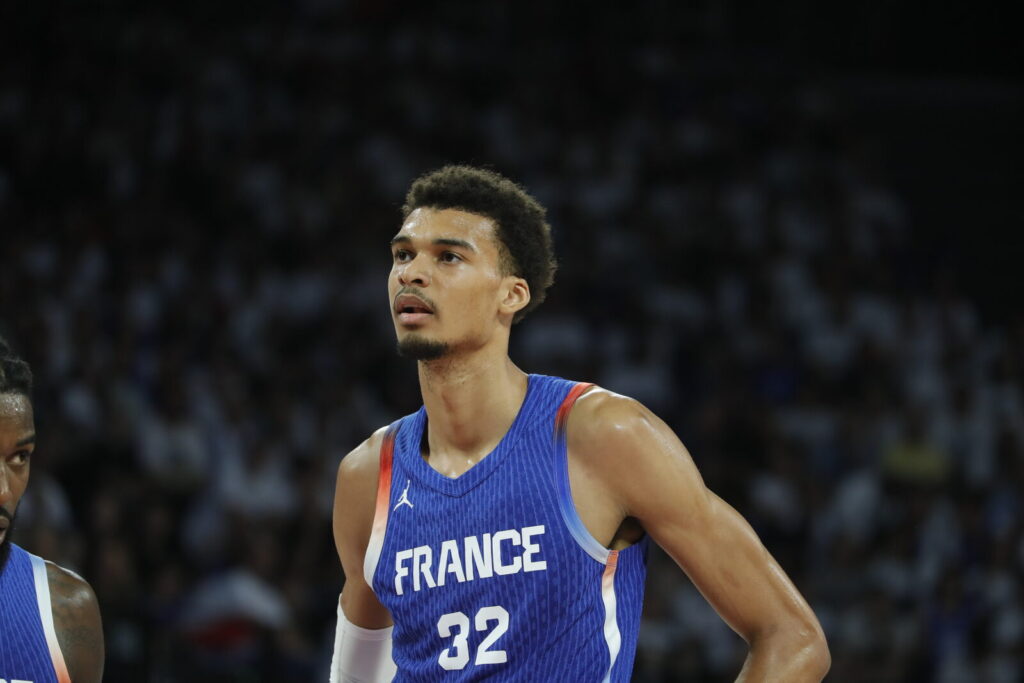
Victor Wembanyama‘s contract extension with the San Antonio Spurs is worth $252 million over five years, the richest deal in franchise history and among the largest rookie-scale extensions the NBA has handed out. The dollar figure only tells part of the story. Wembanyama could have pushed for a deal worth roughly $303 million and chose not to.
The mechanics matter here. Rookie-scale designated extensions come with two ceilings: a 25% share of the salary cap or a 30% “supermax” share for players who hit certain All-NBA, MVP or Defensive Player of the Year triggers. Wembanyama qualified for the higher number after being named the unanimous 2025-26 Kia Defensive Player of the Year at just 22, the youngest winner in league history. He took the lower tier anyway, a decision that leaves close to $50 million on the table across the life of the deal. NBA.com’s own announcement was almost comically restrained, describing the sides as having agreed to “a multi-year contract extension” without naming a figure at all.
San Antonio’s front office, led by general manager Brian Wright, gets something more valuable than a discount: flexibility. Every dollar Wembanyama doesn’t take is a dollar the Spurs can spend extending the rest of a young core that just pushed the franchise to its first Western Conference title since 2014, and its first Finals appearance since the Tim Duncan era ended. San Antonio lost that series to the Knicks in five games, but the roster building around Wembanyama now has real teeth, and its books have room to keep it that way. The deal includes a player option in the fifth season, giving Wembanyama a chance to reopen negotiations if the market moves again before it expires.
Context helps explain why $252 million is both enormous and, in a strange way, modest. Shai Gilgeous-Alexander signed his own rookie-scale max extension with Oklahoma City in 2021 for a base of $172 million over five years, with an All-NBA escalator that could push it to $207 million. That deal looked massive at the time. Four years later, with the salary cap having climbed and Gilgeous-Alexander established as a reigning MVP, he agreed to a fresh extension reported at four years and $285 million, with Spotrac’s more precise accounting putting the fully guaranteed figure just above $273 million. Wembanyama’s rookie-scale number already sits above what Gilgeous-Alexander’s first contract topped out at, which says less about one player outearning another and more about how fast the cap, and star salaries with it, keep rising. It also hints at where Wembanyama’s second contract could land if he keeps this trajectory: the $303 million he turned down this time may look conservative in five years.
The production backs up the price tag. Wembanyama averaged 25.0 points, 11.5 rebounds, 3.1 assists and 3.1 blocks across 64 games this season, shooting 51.2% from the field, while adding an All-Star nod and an All-NBA selection to the DPOY trophy. His postseason numbers barely dipped, 23.8 points and 10.9 rebounds a night across 22 playoff games, evidence that the workload scaled up without his efficiency collapsing. Few players in NBA history have paired that kind of two-way statistical profile with a run to the Finals in their third season.
Wembanyama addressed the extension directly in a post on X the day it was announced. “Spurs family, I’m here to stay,” he wrote. “Whatever it takes.”
That last phrase doubles as a description of the contract itself. San Antonio’s front office has now shown it can build around a discount the way Cleveland did with its own below-market extension last summer, and the Lakers did in a different way when they committed big money in the Austin Reaves extension. The difference is that Wembanyama’s discount came from the player, not the team’s negotiating leverage. Whether that trust pays off in a title probably determines how this contract gets remembered five years from now, long after the $252 million figure stops being the headline.