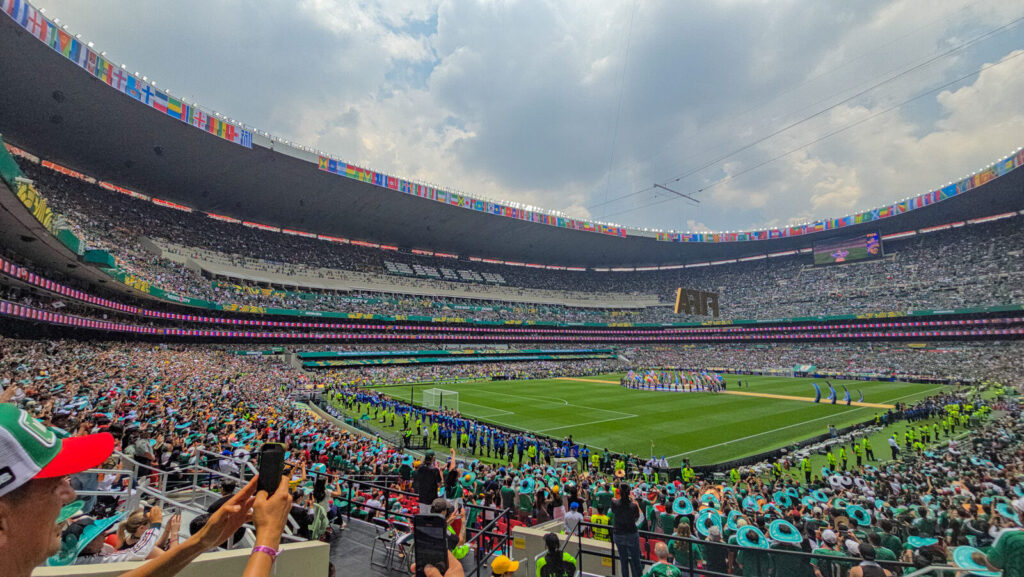
Real Madrid play their home matches in front of roughly 80,000 people. Their social media channels reach a number several thousand times larger: industry trackers reported the club passing 470 million cumulative followers across platforms in 2025, the most of any sports team on earth, with FC Barcelona not far behind. Those numbers are not an accident of fame. They are the output of a deliberate, decades-long strategy that the biggest clubs and leagues in world sport now pursue with the seriousness of a core business line — because that is exactly what it has become.
Teams as media companies
The foundational shift is organisational. Elite clubs no longer treat digital channels as a marketing afterthought; they run them as in-house media companies, with editorial teams, production studios, and publishing schedules that operate year-round. Match highlights are only the start. Training-ground footage, behind-the-scenes documentary series, player challenges, classic-match archives and signing-announcement videos are produced for each platform’s native format — long-form on YouTube, vertical clips for TikTok and Reels, conversation on X.
The logic is straightforward: a club controls unique intellectual property — access to its players and its story — that no broadcaster or creator can replicate. Turning that access into daily content converts casual interest into habitual attention, and habitual attention into commercial value: sponsorship inventory, direct merchandise and ticketing funnels, and first-party data. As we set out in why sponsorship deals are becoming more data-driven, a large, engaged, well-understood global audience is now the single most bankable asset a rights holder can bring to a negotiation.
Speaking the audience’s language — literally
Global reach requires more than translation; it requires localisation. Major clubs and leagues operate dedicated channels in multiple languages — Spanish, Arabic, Japanese, Indonesian and others are common — often with locally based staff producing content tuned to local time zones, platforms and culture. In markets where global platforms are restricted or secondary, teams publish natively: many European clubs and North American leagues maintain substantial presences on Chinese platforms such as Weibo and Douyin, which do not show up in their headline Western follower counts at all.
Player recruitment increasingly carries audience consequences too. A signing from a large, passionate market can move follower numbers measurably within days, and clubs are well aware of it — though sporting merit remains the primary driver at serious institutions. The NBA offers the cleanest case study of athletes as audience bridges: the league’s international stars have helped make basketball genuinely global, a phenomenon we examine in the rise of international stars in the NBA.
Showing up in person: tours and global games
Digital reach is reinforced physically. Preseason tours, once gentle warm-up exercises, are now strategic audience-building events. Manchester United’s 2025 tour of Asia, with matches in Kuala Lumpur and Hong Kong, was reported to be worth around £8 million to the club and drew enormous local crowds and wall-to-wall regional coverage — valuable precisely because South-East Asia is one of the club’s largest follower bases. Most of Europe’s elite now rotate summer visits across North America, Asia, Australia and the Middle East on the same logic.
Leagues do it institutionally. The NBA’s Paris Games in January 2025 generated more than 700 million views across social platforms by the league’s own count, making them the most-viewed edition of its Global Games series. The NFL has expanded its international slate to London, Germany, Brazil and beyond, and in 2025 distributed its São Paulo season-opener free and globally on YouTube — trading short-term rights revenue for worldwide reach. These events are designed as content engines as much as fixtures: every open practice, fan event and city landmark shoot feeds the channels for weeks.
What actually works
Beneath the spectacle, the playbook that separates genuinely global digital operations from large-but-passive ones has a few consistent elements. First, personality over polish: the content that travels furthest is rarely the most produced, but the most human — players being funny, rivalries being teased, dressing-room moments. Second, fluency in fan culture rather than corporate voice; the accounts that thrive participate in the jokes and debates fans are already having, a sensibility explored in how social media changed the way fans follow live games. Third, serialised storytelling — documentary-style access content has proven uniquely effective at converting curious viewers into committed fans, as we discuss in how sports documentaries are driving new fans.
Fourth, and increasingly, owned destinations. Mature teams push followers from rented social platforms toward their own apps and membership programmes, where the relationship — and the data — belongs to the club. A follower on a social network is an audience member; a registered app user with a purchase history is a customer.
The widening gap — and the opening door
The economics of attention reward scale, and the gap between the global elite and everyone else is widening: a handful of soccer clubs, NBA franchises and national teams capture a vastly disproportionate share of worldwide attention. Yet the same tools have lowered the floor. A smaller club with a distinctive voice can now reach audiences that were unimaginable in the broadcast era, and emerging properties — women’s teams prominent among them — have used digital-first strategies to grow followings far faster than their traditional media coverage alone would predict.
The destination for all of this is clear enough. As live rights migrate to streaming platforms — a shift we chart in how streaming is changing sports broadcasting — the teams that own a direct, global, daily relationship with fans will be the ones that prosper, whoever ends up holding the broadcast contract. The badge on the shirt is local. The audience, increasingly, is not.