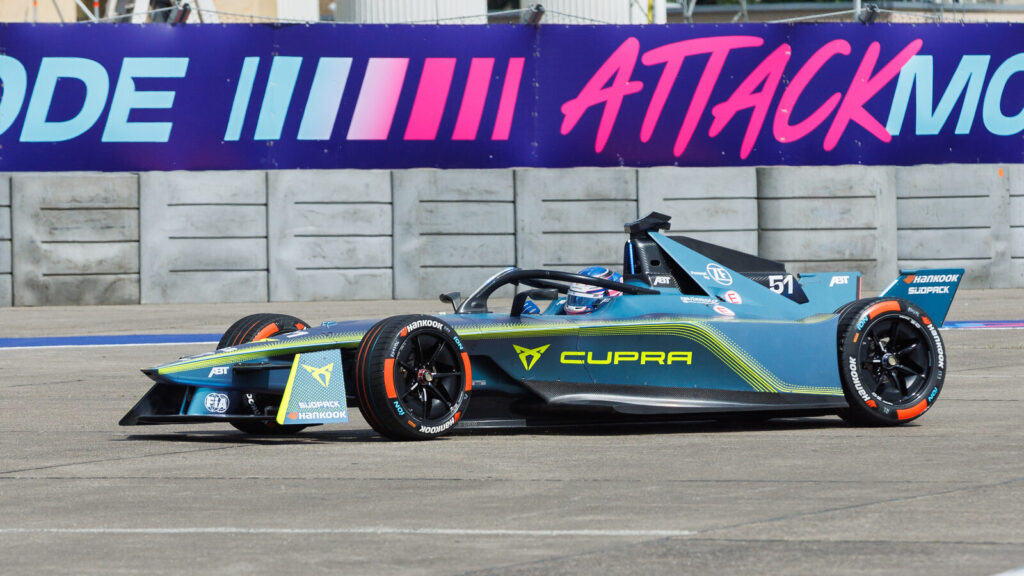
Formula E’s first night race in Japan gets underway July 25-26, 2026, when the TDK Tokyo E-Prix double-header lights up the streets around Tokyo Big Sight in Ariake. New venue, same core question that trips up first-time viewers every season: what is that blue glow around the cockpit, and why does a driver suddenly dive off the racing line for no obvious reason? The answer is Attack Mode, the power-boost mechanic that has defined Formula E strategy since it replaced the old FanBoost system back in 2018-19.
What Attack Mode actually does
Every Gen3 Evo car races at a maximum of 300kW. To unlock more, a driver has to steer through a dedicated Activation Zone marked out on the track, a set of sensor loops embedded in the asphalt away from the fastest, cleanest line through that section. Cross them correctly and the car gains an extra 50kW, jumping to 350kW, along with all-wheel drive for the duration of the boost. The FIA’s official Formula E explainer confirms both figures and the AWD unlock, and the halo above the driver’s head glows blue as a visual cue that the extra power is live.
The catch is built into the geometry. Activation zones sit deliberately off the optimal line, often tucked close to a wall or through a section that costs real lap time to reach. A driver has to choose between holding position on the racing line or sacrificing a second or more to go collect power they will need later. That tradeoff, arm now and lose track position, or wait and risk running out of time, is the entire point of the mechanic.
The clock, not just the switch
Standard E-Prix races allocate eight total minutes of Attack Mode time, and every driver must use it across two separate activations. Race engineers choose the split before lights out: a quick two minutes early paired with a longer six-minute block late, an even four-and-four, or the reverse six-then-two. Races run in the newer Pit Boost format work differently, with drivers taking a single six-minute activation instead of splitting the allowance. Getting the timing wrong, activating too early and having nothing left for a late fight, or waiting so long that traffic blocks a clean run through the zone, has cost drivers positions in past seasons and remains one of the more visible strategic battles a casual viewer can actually follow live.
How it differs from F1’s DRS
It is tempting to lump Attack Mode in with Formula 1’s Drag Reduction System since both hand a driver extra performance mid-race, but the mechanics and intent pull in opposite directions. DRS opens a rear wing flap to cut drag on a straight, and only the car chasing within one second of the car ahead is allowed to use it, turning it into a pure overtaking aid for whoever is behind. Attack Mode is available to anyone, leader included, and it costs time to obtain rather than being granted for free. Where DRS rewards proximity to a rival, Attack Mode rewards a driver willing to gamble position now for horsepower later. It is closer in spirit to a fuel-strategy call than to a push-to-pass button.
That gamble is also why broadcasters and teams treat the zone placement as part of each circuit’s character. Street tracks already punish mistakes with concrete walls a few feet from the racing surface, so putting the Activation Zone somewhere awkward, rather than in a wide, safe runoff area, keeps the risk real. A zone that costs nothing to reach would turn Attack Mode into a formality instead of a decision.
Tokyo’s Ariake layout is new to the calendar this weekend, so exactly how teams will play the two-activation math on a street circuit nobody has raced before is one of the more interesting subplots heading into the night session, separate from whatever the results end up being. Readers who like this kind of rules-and-strategy breakdown from single-seater racing more broadly can find related reading on how McLaren manages its own internal team orders in F1 or in this look at why passing is so difficult at a track like the Hungaroring, both filed under Playbook Wire’s Racing coverage.
None of this requires an electrical engineering degree to enjoy trackside or on a stream. Watch for the blue halo, watch for a car ducking off-line into a marked box, and the rest of the race starts to make a lot more sense.