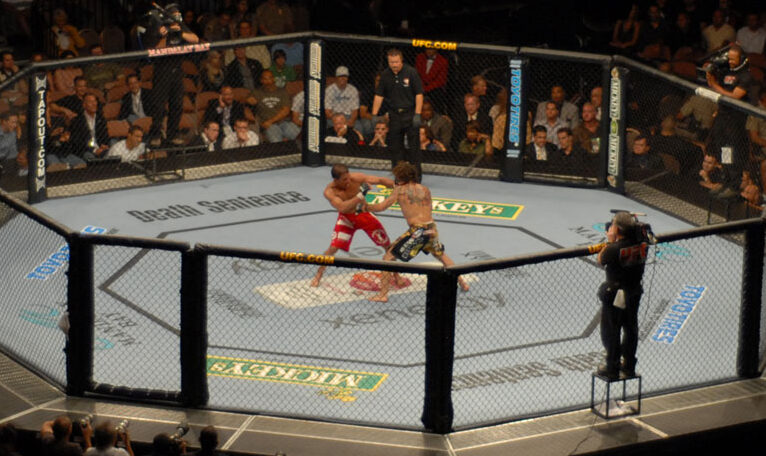
Search “how do UFC judges score a fight” and you will find plenty of outrage and very little explanation. The truth is that the scoring system has a fixed order of priorities, and once you know it, split decisions stop looking random and start looking like the predictable result of three people watching the same fight through slightly different lenses.
Every UFC bout uses the 10-point must system, borrowed from boxing and written into the Unified Rules of Mixed Martial Arts. The winner of a round must receive 10 points. The loser gets 9 or fewer, unless the judge decides the round was truly even, which is rare enough that most fans never see it happen live.
What Judges Actually Weigh First
The Unified Rules of MMA lay out a strict pecking order. Judges look first at effective striking and effective grappling, meaning legal strikes and positions that land clean, cause damage, or move a fighter toward finishing the bout. Only if that category is dead even do they move to effective aggressiveness, rewarding the fighter who forced the pace. Octagon control, dictating where the fight happens, sits last, and the rulebook itself says that criterion should be “assessed very rarely.” A fighter who backs up and lands the harder shots still wins the round over an opponent who marches forward and misses.
What Turns a Round Into a 10-8
Most rounds end 10-9. A 10-8 requires one fighter to have dominated almost the entire five minutes, whether through a knockdown, a sustained beating on the feet, or a grappling position so total that the other fighter had no real chance to respond. A single takedown with a few strikes rarely qualifies. A fighter getting rocked, dropped, and swarmed for the last two minutes of a round usually does. Judges can, in theory, go to 10-7 for something even more one-sided, though it shows up so infrequently that many longtime fans have never seen one scored live.
Split, Majority, and Unanimous, What the Words Mean
A unanimous decision means all three judges scored the fight for the same fighter, round totals and all. A majority decision means two judges agreed on a winner while the third scored it a draw. A split decision means the judges genuinely disagreed, two seeing it one way and one seeing it the other. Split decisions are not proof of bad judging by themselves. They are what happens when three competent people apply the same criteria to three or four rounds that were each close enough to go either way.
A Real Scorecard: Lawler vs. Condit’s Split Headache
The clearest way to see this play out is UFC 195, where Robbie Lawler defended his welterweight title against Carlos Condit in one of the sport’s most replayed five-round wars. Two judges scored it 48-47 for Lawler, while the third had it 47-48 for Condit, a split decision. According to the round-by-round breakdown logged at MMA Decisions, Condit took rounds one and four on all three cards, largely on volume striking, while Lawler took rounds two and five on all three cards by finishing rounds strong and edging the scrambles. One judge flipped the third round to Condit, which alone explains the outcome. Nobody watching that fight thought either man was robbed. The scorecards diverged because the middle rounds were close enough that reasonable eyes landed on different fighters.
Damage or Volume? What Actually Tips a Round
This is the question that drives most post-fight arguments. The rules do not ask judges to count total strikes landed. A fighter throwing a high volume of glancing jabs can still lose a round to an opponent who lands fewer but harder shots that visibly hurt them, wobble their legs, or open a cut. Damage, defined loosely as anything that reduces a fighter’s ability or willingness to keep competing, carries more weight than sheer output. That is why a fighter can “lose” the strike count on the broadcast graphic and still win the round on paper, and it is also why judges sitting cageside sometimes see visible effects that a stat counter never captures.
None of this guarantees judges will always agree, and it never will, since the rules ask for a human read on a fast, chaotic sport. But knowing the actual order of criteria, striking and grappling first, aggression second, control last, turns most “robbery” arguments into a much simpler question: which fighter actually did more damage in the rounds that mattered. For fighters who settle things before the cards ever matter, like Paddy Pimblett’s finish that reshaped the lightweight picture, judging never becomes a factor at all. For everyone else, understanding the criteria is the difference between shouting at the screen and knowing exactly why the hand went up the way it did, the same kind of behind-the-scenes logic that shapes how the sport ranks its own fighters in the UFC’s pound-for-pound rankings.