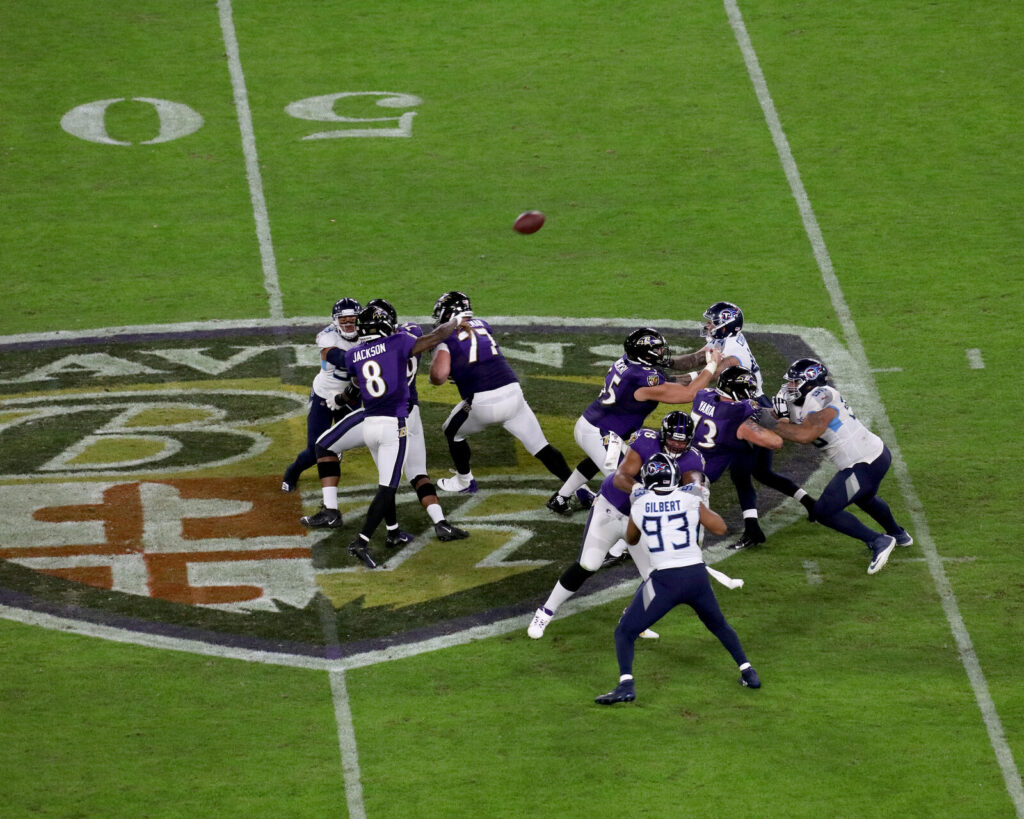
Baltimore solved its short-term math problem in March, but the bigger equation involving Lamar Jackson’s future is still sitting on the whiteboard. The Ravens restructured the two-time MVP’s contract, according to the team’s own announcement, to create immediate salary cap room, a move that buys the front office flexibility for this season while leaving the harder question, a long-term extension, unresolved.
The mechanics of the restructure are straightforward even if the stakes are not. Jackson’s 2026 salary cap figure, which had ballooned to roughly $74.5 million, was cut down to approximately $34.54 million after the Ravens converted a large chunk of his base salary into a signing bonus and spread the charge across future years. That maneuver freed up close to $40 million in space for a team that needed room to address its own pending free agents. The tradeoff shows up down the road: Jackson’s 2027 cap number now climbs to roughly $84.49 million, a figure that essentially borrows against the future to pay for the present.
None of that changes the calendar. Jackson signed his current deal, a five-year contract, before the 2023 season, and the restructure leaves him with two seasons remaining on the books. Barring a new agreement, he would reach unrestricted free agency after the 2027 season, an outcome that would be almost unthinkable for a two-time league MVP still playing at a high level, yet one that becomes increasingly plausible the longer negotiations drift.
Ownership has made its preference known. Ravens owner Steve Bisciotti has said he wants an extension finalized well before Jackson’s situation becomes a full-blown offseason storyline, telling reporters the urgency matters to him partly because Baltimore has its own pending free agents and does not want a quarterback question hanging over the building during that process. General manager Eric DeCosta has taken the opposite approach in public, repeatedly declining to detail where talks stand. He has called negotiating in the open counterproductive, preferring instead to keep the give-and-take with Jackson’s camp private while insisting a new deal remains a top priority.
That gap between an owner voicing urgency and a general manager keeping details locked down is not unusual in NFL contract negotiations, but it does create a strange middle ground: the cap problem is patched, the relationship is intact, and yet nobody outside the building actually knows how close a long-term agreement is.
Where would Jackson’s next contract land if talks resume in earnest? Recent top-of-market quarterback deals offer a rough guide, even if none of them carry an MVP resume like his. Joe Burrow’s five-year, $275 million extension with Cincinnati set the per-year bar at $55 million when it was signed, with more than $219 million in guarantees. Justin Herbert’s five-year, $262.5 million deal in Los Angeles landed at $52.5 million annually. Jared Goff’s four-year, $212 million extension in Detroit came in at $53 million per year with $170 million guaranteed. Dak Prescott then reset the market entirely with a four-year, $240 million deal in Dallas worth $60 million annually and $231 million guaranteed, including an $80 million signing bonus. Josh Allen topped even that in total value with a six-year, $330 million contract in Buffalo, worth $55 million per year with roughly $250 million guaranteed over the life of the deal.
Stack Jackson’s restructured, short-term cap numbers next to those figures and the contrast is obvious. He is playing on a patched-together arrangement built to survive one season, while the market around him has moved toward guarantees exceeding $200 million and annual values north of $50 million for quarterbacks without his trophy case. A two-time MVP re-entering that market, especially one who has already been the league’s highest-paid player once before, would be positioned to challenge whatever the going rate is by the time a deal actually gets done.
For now, the restructure buys Baltimore a season of cap relief and buys Jackson nothing beyond the two years he already had. The quarterback position has never been more expensive to retain, and the Ravens’ handling of this negotiation, patient in public, reportedly ongoing in private, will say as much about their roster-building philosophy as any trade or free agent signing this offseason. It sits alongside other market-moving deals league-wide, including the kind of positional ripple effects seen in recent pass-rusher contracts that have reset expectations at other spots on the roster.
What happens next depends on two people who are not saying much publicly. Bisciotti wants urgency. DeCosta wants privacy. Jackson, for his part, has never been a conventional negotiator, and the dead money consequences of letting this drag deep into 2027 would eventually force the issue regardless of anyone’s preference for how quietly it gets handled.