Formula 1 spent fifteen seasons leaning on a single gadget to manufacture passes. The Drag Reduction System opened a flap on the rear wing, cut drag in a marked zone, and gave a chasing driver a speed bump if they were within a second of the car ahead. It worked well enough to become a punchline as often as a highlight. For 2026, the FIA scrapped it entirely and replaced it with wings that move on every car, on every straight, all race long, plus a separate energy boost aimed squarely at the business of overtaking. Months into the new formula, the early numbers suggest the swap has changed the racing more than almost anyone forecast.
Why DRS Had to Go
DRS always had a credibility problem. It rewarded proximity rather than skill and did nothing for a driver more than a second back or defending in the wrong zone. The FIA’s stated goal for 2026 was cars that could follow each other closely without an artificial crutch, achieved through a narrower, shorter, lighter chassis designed to cut the turbulent wake a car throws off its rear end. Reducing that dirty air was meant to matter more than any single gadget, with the active aero system built to work alongside it.
Corner Mode, Straight Mode, and a Wing That Never Stops Moving
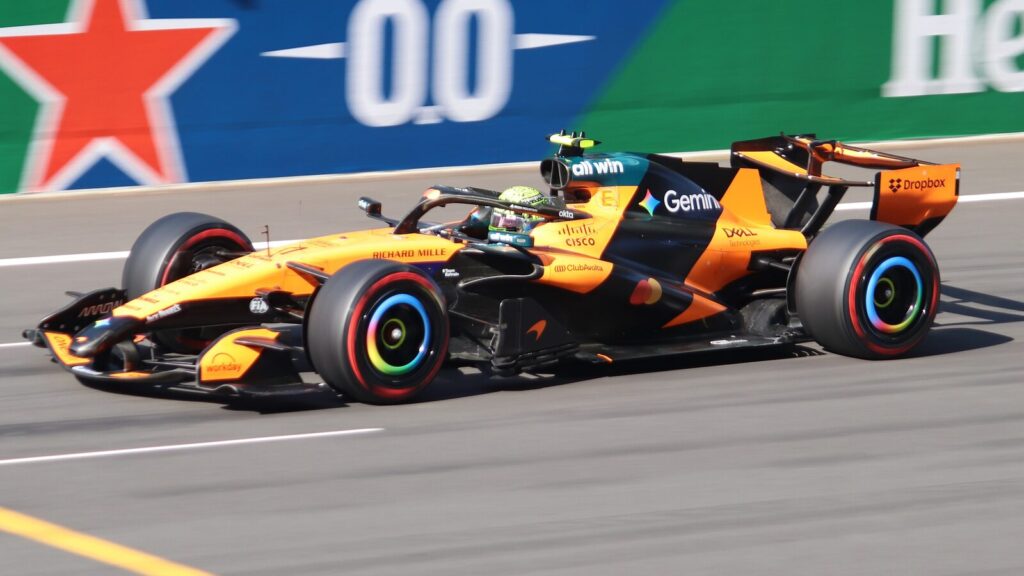
Every 2026 car carries front and rear wings with moveable elements that behave like a set of blinds. In Corner Mode, the flaps close to maximize downforce, giving drivers the grip to carry speed through the apex. In Straight Mode, those same flaps open to flatten the wing profile, cutting drag and unlocking top speed. The critical difference from old-style DRS is availability. Straight Mode can be triggered by any driver at designated points on a circuit, regardless of whether a rival is within a second of them. It is a permanent efficiency tool first, tuned around energy conservation as much as outright overtaking.
Overtake Mode: The Real DRS Replacement
The actual passing weapon lives elsewhere, in what the regulations label Manual Override Mode and what teams and broadcasters have settled on calling Overtake Mode. When a driver closes to within one second of the car ahead at a marked activation point, they unlock extra electrical deployment, worth roughly an additional 0.5 megajoules for the following lap, pushing power unit output toward 350kW. A trailing car can sustain that power out to around 337 km/h, while the lead car’s own energy tapers off past 290 km/h as its battery depletes. That gap in available power, rather than a flap opening on cue, is what closes the distance into a braking zone. A driver can spend the boost all at once or spread it across the lap, turning energy management into as much of a tactical battle as the pass itself.
What the Numbers Actually Show
Formula 1 itself promoted the results, and the headline figure is real and independently verifiable: the 2026 Australian Grand Prix produced roughly 120 on-track passes at Melbourne, against 45 in 2025, a jump the sport highlighted as a near-tripling rather than a mere doubling. Suzuka pointed in the same direction. The 2025 Japanese Grand Prix, traditionally one of the stingiest circuits on the calendar for passing, produced only 15 overtakes, and race coverage of the 2026 event described a noticeably busier afternoon, though a precise final count is harder to pin down than Australia’s widely cited figure. Shanghai’s numbers are murkier still, with no consistently sourced tally available for either year. Australia’s near-tripling is the clearest, best-documented data point of the opening rounds. It suggests a car that genuinely races differently with a rival in its mirrors, even if the scale of the gain at other early-season circuits is less settled than some recaps imply.
Not All Overtakes Are Created Equal
Serious analysts have added a caveat. Because Overtake Mode can be deployed and then exhausted within a single lap, some of the extra passes are what commentators call “yo-yo racing,” where a driver uses their energy advantage to get ahead only to be repassed once their own battery runs low on the next straight. That inflates the raw count without necessarily producing better racing, and overtaking totals have always been a blunt instrument, sensitive to strategy splits, safety cars, and how spread out a field happens to be. Even accounting for that noise, Melbourne’s near-tripling and Suzuka’s busier afternoon point in the same direction, an abrasive layout and a tight technical circuit both racing differently under the new rules, even if Shanghai’s exact scale is harder to pin down.
What to Watch as the Season Continues
The bigger test for active aero and Overtake Mode comes at circuits where 2025’s DRS-era racing was already thin, and at street tracks where the margin for error is smallest. If the doubling trend holds there, F1 will have solved a problem that outlasted a decade and a half of wing tweaks and DRS zone tinkering. For the wider technical picture, the sport’s official breakdown of the 2026 aerodynamic rules is worth a look. More race-by-race context sits in the Playbook Wire Racing hub, including recent coverage of Leclerc’s win at Silverstone, and further number-driven breakdowns on the Data & Analytics page.